You can build a better jump all preseason without touching a pit.
The plyo ladder
Climb one rung at a time. Move up when the rung feels easy and your legs read green the next morning.
- Pogo jumps (Session 2): "toes up," "stiff ankle," "pop."
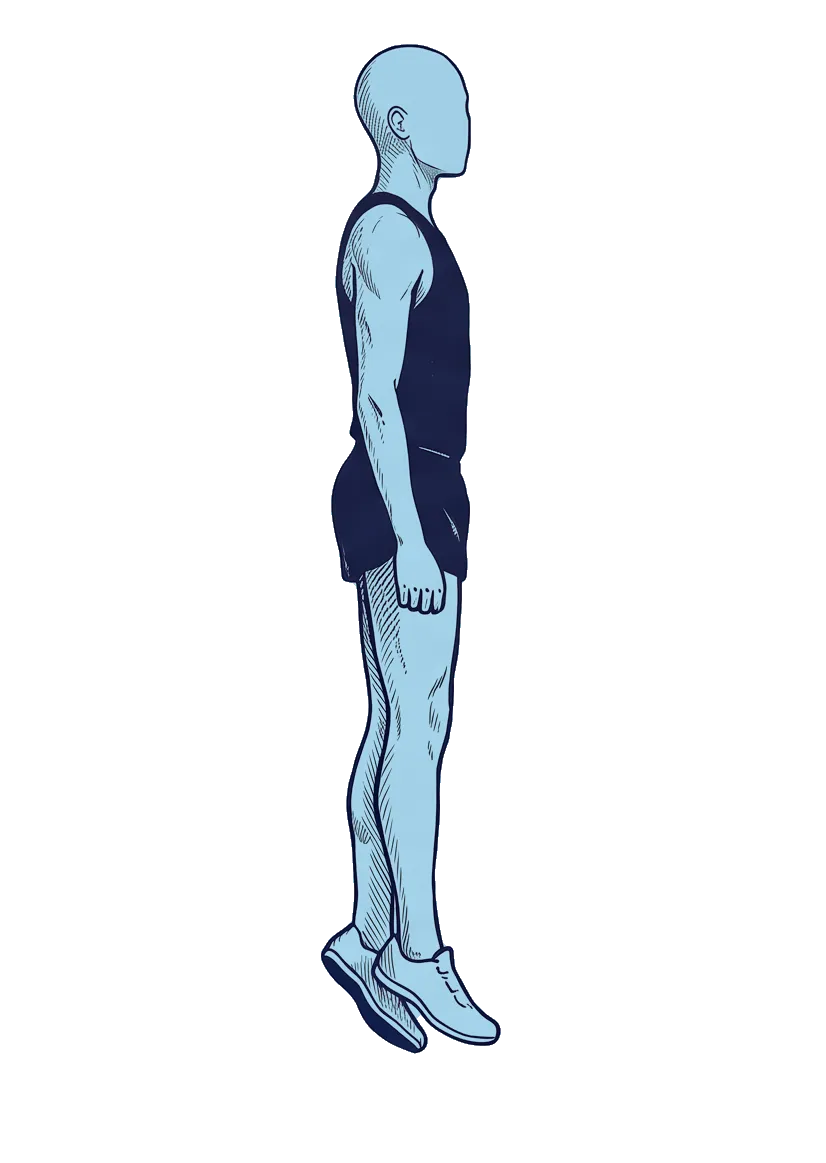
- Single-leg hops, 3 x 5 each leg (Session 3): "forward not up," "knee drives," "under the hip." Your weaker leg shows up here, and now you know what to train.
single-leg-hopsimage pending - Rhythm bounding, 30 m (Session 3, once hops feel easy): "same rhythm," "drive forward," "even sounds."
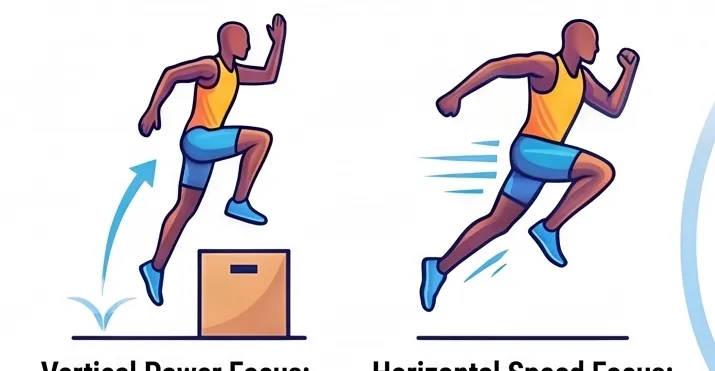
- Five-step pop-ups (last week of Session 3 on): "long," "short," "pop."
short-approach-pop-upsimage pending
That order is our rule. Depth jumps wait until practice starts, when your coach can watch them.
Count your takeoffs
Every hop, bound, landing, and takeoff is one contact. Standing drills count half. Stay inside your session budget on the Weekly Tracker. Our rule.
Runway rhythm, no pit needed
- Continuous takeoffs: "step," "step," "pop," eight to ten takeoffs over 50 m.
continuous-takeoffsimage pending - Box-ground-box: "down," "quick," "up." This is how your second-to-last step should feel: hips lower, then gone.
box-ground-boximage pending
Triple jump: save the step
Most high school triple jumpers lose the jump in the step, and a hop that goes too high is usually the cause. Keep it low and long.
- Standing triple jump: "same," "other," "both."
standing-triple-jumpimage pending - Low hop: your hop should feel boring. That means it is right.
- Hop-to-step: "land and launch," "ground is hot," "knee to chest," "hold."
hop-to-stepimage pending
What the first week of practice looks like
Week one of practice is five-step approaches, standing triple jumps, and no tape measure. Show up with a ladder already climbed.
Go deeper: the Long Jump Coaching Handbook, the Triple Jump Coaching Handbook, and Runway Mastery for approach consistency.
Track and Field Lab is a STEMsaic Media property. © STEMsaic Research Impacts LLC. All rights reserved.